Comprehensive naturopathic care for bipolar disorder, Bipolar I, Bipolar II, and cyclothymia. Focused on understanding individual patterns of mood, energy, sleep, and contributing factors as part of a comprehensive approach to long-term care.
Bipolar Spectrum Conditions
Symptoms of Bipolar Disorder
Periods of unusually elevated mood
Increased energy or activity
Decreased need for sleep
Racing thoughts
Increased talkativeness
Increased impulsivity
Difficulty concentrating
Irritability or agitation
Periods of persistent low mood
Loss of motivation
Fatigue
Changes in sleep or appetite
Bipolar Disorder involves distinct changes in mood and energy that differ from a person's usual baseline. The pattern, duration, and severity of these changes are important parts of evaluation.
What May Be Contributing to Bipolar Disorder?
Sleep disruption
Chronic stress
Medication changes
Substance use
Hormonal changes
Blue light and Spring-time sun
My Treatment Approach
More Time. Deeper Evaluation. A Different Approach to Bipolar Disorder
The average physician visit is approximately twelve minutes. In twelve minutes, there is only so much that can be accomplished. A history must be taken, symptoms evaluated, a diagnosis considered, and a treatment plan developed—often with very little time to explore the deeper patterns that may be contributing to a complex condition.
The limitations of conventional diagnostic encounters are reflected in the medical literature. Studies comparing clinical diagnoses with postmortem findings have found substantial discrepancies between what was believed to be occurring during a patient's life and what was ultimately discovered at autopsy. In one UK study of critically ill patients, the pre-death diagnosis was in complete agreement with postmortem findings in fewer than half of cases. [1]
This doesn't mean that conventional medicine is ineffective. When the diagnosis is correct and the treatment works, it can be tremendously valuable.
But complex conditions often require more time.
My Approach to Bipolar Disorder
My first appointment typically lasts 2–4 hours.
That additional time allows me to go far beyond a brief symptom-focused encounter. I take a detailed history, examine the evolution and patterns of your symptoms, look for relationships between seemingly unrelated symptoms, and explore factors that may be contributing to vestibular migraine.
The objective is not simply to put a label on your symptoms.
It is to understand why they are occurring.
Once I have developed a comprehensive picture of your health, I can create an individualized treatment strategy directed at the factors that may be contributing to your symptoms.
Two Fundamental Principles
First, remove the obstacles to cure.
Identify and address factors that may be interfering with the body's ability to regulate, recover, and heal.
Second, provide a gentle healing stimulus.
Once obstacles have been addressed, provide individualized support designed to encourage the body's own capacity for regulation and recovery.
More time allows for a deeper evaluation.
A deeper evaluation allows for a more individualized approach.
Understanding Bipolar Spectrum Conditions
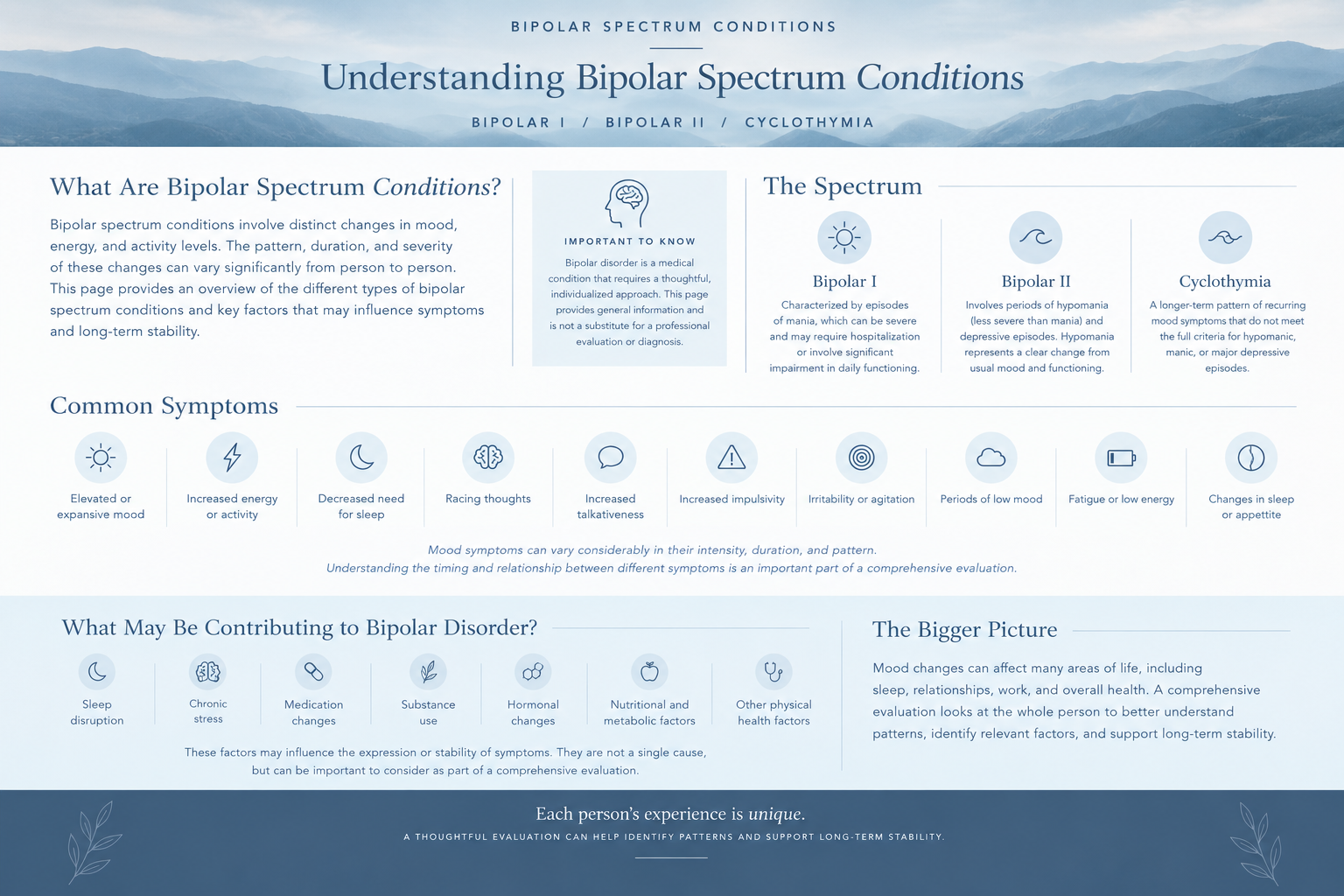
Bipolar spectrum conditions involve distinct changes in mood, energy, activity, and sleep. The pattern, duration, and severity of these changes can vary considerably between individuals.
Bipolar I involves episodes of mania, which can be severe and may significantly impair daily functioning or require hospitalization.
Bipolar II involves episodes of hypomania and major depression. Hypomania is less severe than mania but represents a distinct change from a person's usual mood and functioning.
Cyclothymia involves recurring periods of hypomanic and depressive symptoms that do not meet the full criteria for hypomanic, manic, or major depressive episodes.
Collaborative Care
Bipolar Disorder can benefit from specialized psychiatry. Naturopathic care may be used alongside appropriate psychiatric and psychological care, with treatment decisions based on the individual's circumstances and goals.
Are you already working with a psychiatrist or therapist?
Your existing mental-health team can remain an important part of your care. My role is to evaluate the broader health picture and address factors that may be relevant to your overall well-being and mental health care.
FAQs
-
The main difference between Bipolar 1 and Bipolar 2 is the intensity and severity of the elevated mood episodes, with Bipolar 1 involving full mania and Bipolar 2 involving milder hypomania paired with major depression.
Bipolar 1 has at least one full manic episode that lasts for at least seven days, or is severe enough to require immediate hospital care. The manic episode looks like extremely high energy, racing thoughts, rapid speech, reckless behavior (such as major financial risks), and sometimes psychosis like delusions or hallucinations. Major depression does not have to happen, but sometimes does.
Bipolar 2 has a pattern of at least one hypomanic episode and at least one major depressive episode. Hypomania is a less intense form of mania. You feel very energetic and productive, but it does not include psychosis or require a hospital stay. Often the most debilitating part of Bipolar 2 is the presence of a major depressive episode.
-
Sometimes referred to as Bipolar 3 Disorder, it continues the lessening of the intensity from Bipolar 1 to 2 to 3, but has more rapid shifts from the elevated feelings to the depression.
During Hypomania, you feel very energetic, creative, happy, or irritable. You may talk fast or need less sleep.
During mild depression, you feel sad, tired, unmotivated, or empty. You may lose interest in things you usually like.
To get a diagnosis, these mood shifts must last for at least two years in adults (or one year in children and teens). Stable moods between shifts rarely last longer than two months.
-
Yes. BPD frequently occurs alongside both Anxiety and Depression.
Bipolar Disorder is defined in part by alternating episodes of depression and mania or hypomania. Depressive episodes are a core component of the disorder itself.
Anxiety frequently co-occurs with Bipolar Disorder. Conditions like generalized anxiety disorder (GAD), panic disorder, and social anxiety are very common in people with Bipolar illness.
Having Anxiety or Depression alongside Bipolar Disorder can make mood swings more frequent, intense, or severe.
-
Several factors can disrupt mood stability in bipolar spectrum disorders. Biological, psychological, and environmental factors all may play a role.
Changes in sleep-wake cycles, called circadian rhythm disruption, such as shift work, or jet lag can trigger shifts toward mania or depression
Fluctuations in brain chemicals like dopamine, serotonin, and norepinephrine affect energy, focus, and emotional contro
Inherited traits and internal clock genes (such as CLOCK and BMAL1) influence vulnerability to mood episodes.
Oxidative stress and mitochondrial dysfunction in brain cells can lower the brain's resilience against mood swings.
Major changes, grief, relationship breakups, or high-pressure situations often precipitate acute episodes.
Drinking alcohol or using recreational drugs interferes with brain chemistry and lowers medication effectiveness.
Changes in daylight hours during different times of the year can alter body rhythms and provoke depressive or manic symptoms.
Vivid mental images of future events can amplify anxiety, excitement, or depression, leading to emotional instability.
-
Mainstream treatment for Bipolar 1 disorder combines long-term medication and psychotherapy to manage severe mood episodes, prevent relapses, and maintain daily stability
In my practice, I have seen homeopathic treatment excel in BPD, when combined with naturopathic treatment. The power of homeopathy is in its ability to focus on the individual’s experience of BPD. What happens during mania? Is it an impulse to buy extravagant things? Or a desire to walk for days? Does it go into a destructive anger? Is there a propensity to rhyme or even rap when speaking? Going into that level of detail is where naturopathic medicine really shines.
-
Yes, if there is a prescribing psychiatrist, I prefer to have them on board with my own work, so that they can manage the pharmaceutical portion, and I can manage the naturopathic portion. I sometimes prescribe pharmaceutical medications to my patients, if that is there preference. But most of my patients come to me wanting to reduce or eliminate psychotropic medications.
Therapy is the number one referral I make in my practice. CBT helps patients identify negative thought patterns, manage stress, and recognize personal episode triggers. FFT involves loved ones to improve communication, educate the household on the condition, and spot early warning signs.