OCD
Comprehensive naturopathic care for obsessive-compulsive disorder and related symptoms. Focused on understanding the individual factors that may contribute to symptom severity and developing an individualized treatment approach.
Symptoms of OCD
Intrusive thoughts
Unwanted images or impulses
Excessive doubt or uncertainty
Repetitive behaviors or rituals
Checking
Reassurance seeking
Mental compulsions
Fear of contamination
Fear of harming yourself or others
Need for symmetry or exactness
Difficulty tolerating uncertainty
Significant anxiety or distress
OCD can take many forms, and the thoughts or behaviors that accompany it can vary considerably from person to person. The presence of an unwanted thought does not mean that a person wants to act on it.
What May Be Driving OCD?
Chronic stress
Sleep disruption
Nervous-system dysregulation
Hormonal changes
Nutritional or metabolic factors
Inflammatory or immune factors
Medication or substance effects
Environmental contamination
Infectious factors
My Treatment Approach
More Time. Deeper Evaluation. A Different Approach to OCD
The average physician visit is approximately twelve minutes. In twelve minutes, there is only so much that can be accomplished. A history must be taken, symptoms evaluated, a diagnosis considered, and a treatment plan developed—often with very little time to explore the deeper patterns that may be contributing to a complex condition.
The limitations of conventional diagnostic encounters are reflected in the medical literature. Studies comparing clinical diagnoses with postmortem findings have found substantial discrepancies between what was believed to be occurring during a patient's life and what was ultimately discovered at autopsy. In one UK study of critically ill patients, the pre-death diagnosis was in complete agreement with postmortem findings in fewer than half of cases. [1]
This doesn't mean that conventional medicine is ineffective. When the diagnosis is correct and the treatment works, it can be tremendously valuable.
But complex conditions often require more time.
My Approach to OCD
My first appointment typically lasts 2–4 hours.
That additional time allows me to go far beyond a brief symptom-focused encounter. I take a detailed history, examine the evolution and patterns of your symptoms, look for relationships between seemingly unrelated symptoms, and explore factors that may be contributing to vestibular migraine.
The objective is not simply to put a label on your symptoms.
It is to understand why they are occurring.
Once I have developed a comprehensive picture of your health, I can create an individualized treatment strategy directed at the factors that may be contributing to your symptoms.
Two Fundamental Principles
First, remove the obstacles to cure.
Identify and address factors that may be interfering with the body's ability to regulate, recover, and heal.
Second, provide a gentle healing stimulus.
Once obstacles have been addressed, provide individualized support designed to encourage the body's own capacity for regulation and recovery.
More time allows for a deeper evaluation.
A deeper evaluation allows for a more individualized approach.
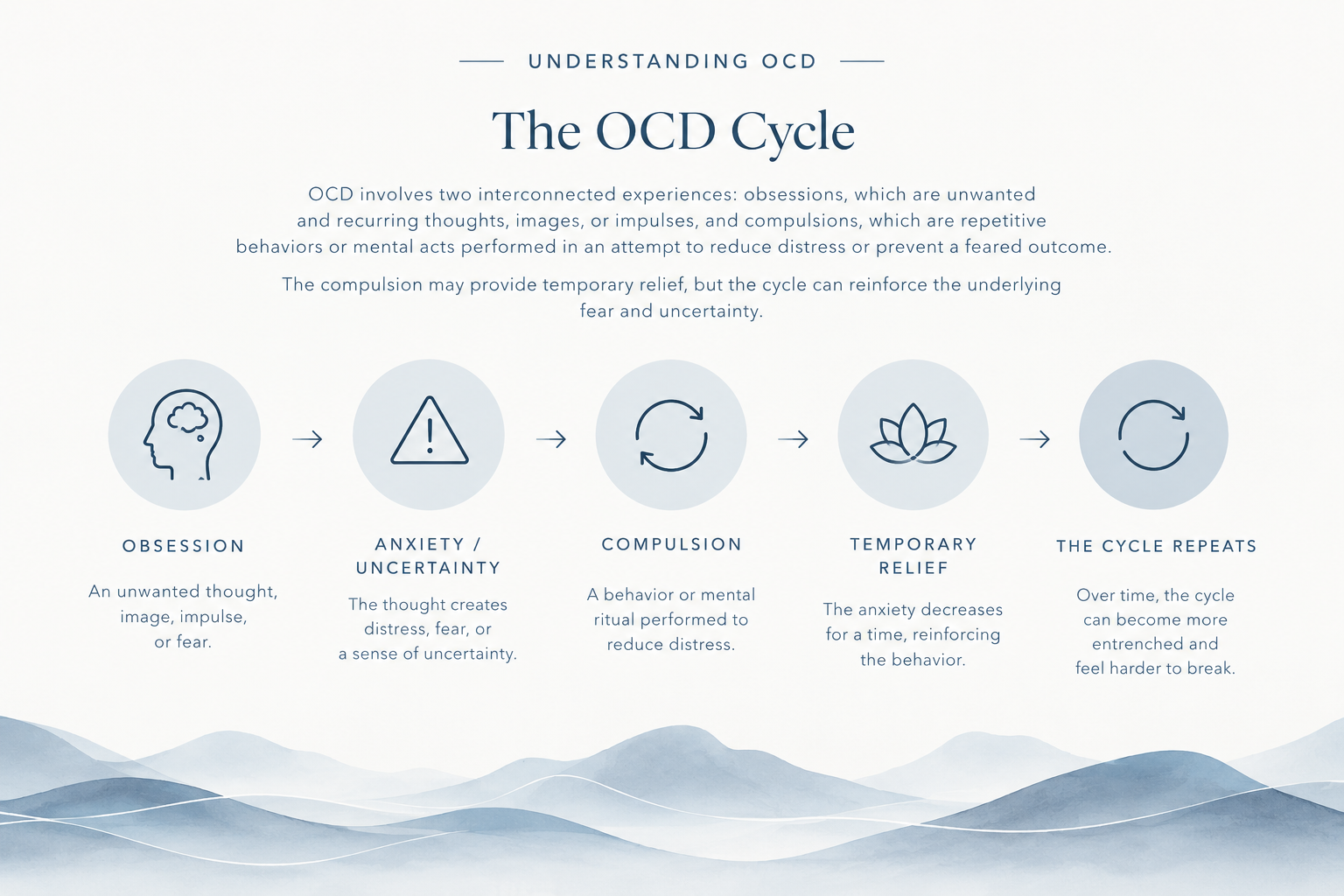
Understanding OCD
OCD involves two interconnected experiences: obsessions and compulsions. Obsessions are unwanted, recurring thoughts, images, or impulses that can cause significant distress. Compulsions are repetitive behaviors or mental acts performed in an attempt to reduce that distress or prevent a feared outcome.
Compulsions may provide temporary relief, but the cycle can reinforce obsessive thoughts and compulsive behaviors over time.
Different Presentations of OCD
Contamination & Cleaning
Fear of contamination accompanied by washing, cleaning, or avoidance.
Checking & Responsibility
Repeated checking or seeking certainty about safety, mistakes, or responsibility.
Intrusive Thoughts
Unwanted thoughts or images involving harm, sexuality, religion, relationships, or other personally distressing themes.
Symmetry & Exactness
A need for things to feel "just right," symmetrical, ordered, or complete.
Purely Obsessional OCD
Intrusive thoughts accompanied primarily by mental compulsions rather than obvious outward rituals.
HOW DOES NATUROPATHIC TREATMENT DIFFER?
A comprehensive evaluation looks beyond the content of the obsessive thoughts to understand when symptoms began, what makes them better or worse, how compulsions function, how sleep and stress affect symptoms, and what other physical or neurologic symptoms may be present.
Understanding the individual pattern can help determine which contributing factors deserve further attention.
The health history in any in depth evaluation is of paramount importance. Often times there are underlying physiological concerns that are contributing to the imbalance that is manifesting as OCD.
A growing body of evidence suggests that OCD in children may be triggered by a streptococcal (strep) infection. Strep throat is present in the health history of many children who later develop behavior changes, including OCD. This condition is called PANDAS (pediatric autoimmune disorders associated with streptococcal infections).
Along with streptococcal infections, other pathogens such as Toxoplasma gondii have been implicated in the pathophysiological models of OCD. T. gondii is present in cat feces, and undercooked meat. Research suggests that there may be a link between the two.
COLLABORATIVE CARE
OCD can benefit from specialized psychotherapy, particularly exposure and response prevention (ERP). Naturopathic care may be used alongside appropriate psychiatric and psychological care, with treatment decisions based on the individual's circumstances and goals.
Are you already working with a psychiatrist or therapist?
Your existing mental-health team can remain an important part of your care. My role is to evaluate the broader health picture and address factors that may be relevant to your overall well-being.
FAQs
-
Normal worrying focuses on real-life problems and practical concerns that can be resolved, whereas Obsessive-Compulsive Disorder (OCD) involves repetitive, intrusive thoughts paired with specific physical or mental rituals designed to neutralize distress.
Normal worrying focuses on things like bills, deadlines, or relationships. It follows a logical path, and tends to fade once the problem is solved or the situation changes. Normal worries can typically be set aside for the time being, so that you can carry on with your day.
OCD features unwanted, repetitive thoughts, urges, or images that feel irrational, out of character, or deeply distressing. The big thing that sets OCD apart from worry, is the compulsions. The obsession in OCD requires performing specific physical acts (like excessive handwashing or door checking) or mental acts (like counting or reviewing memories) to ease the intense anxiety.
OCD demands an immediate answer, trapping the brain into a persistent cycle of temporary relief followed by renewed panic. It typically consumes significant time in one’s day, and heavily disrupts daily functioning, work, and relationships
-
Yes, this is typically what happens with OCD. The thoughts become intrusive, and go against what you logically would choose to focus on in your life.
Obsessions in OCD are involuntary and pop into the mind unexpectedly. They frequently latch onto the things you care about most, which is why the content feels so disturbing and unwanted.
OCD tricks the brain into believing that having a thought means you want to act on it. Trying hard to push these unwanted thoughts away actually causes a rebound effect, making them stick around longer and feel more intense.
-
Obsessions are unwanted intrusive thoughts or urges.
Compulsions are competitive physical or mental actions performed to ease the intensity of those thoughts.
Obsessions cause anxiety. They are thoughts that come into your mind, that cause distress. They are often centered around fears. For example, fear of germs, or fear of intruders.
The compulsions then set in. They are repetitive behaviors that you introduce into your present state, that initially were brought in to ease the fears. But over time, they become a ritualistic set of actions that you feel compelled to perform. For example, in fear of germs, the compulsion may be washing your clothes 3 times. In the fear of intruders, it might be checking to make sure the door is locked 6 times.
-
Yes, OCD frequently occurs along side both anxiety and depression.
Anxiety may seem obvious. Distressing intrusive thoughts bring on more anxiety. It becomes a feed back loop.
Over time, the distress can leave you feeling fatigued or even burnt out. You can feel overwhelmed, or just sick of dealing with the same old stuff over and over again. You want it to end, but your brain traps you into the cycle. Then the depression sets in.
-
Mainstream treatment of moderate to severe cases of OCD frequently involves combining exposure therapy with a medication like a Serotonin Specific Reuptake Inhibitor.
In my practice, I have seen homeopathic treatment excel in OCD, when combined with naturopathic treatment. The power of homeopathy is in its ability to focus on the individual’s experience of OCD. What is the fear? What is the compulsion? What does that feel like inside your body? What makes it better? What makes it worse? Going into that level of detail is where naturopathic medicine really shines.
-
Yes, if there is a prescribing psychiatrist, I prefer to have them on board with my own work, so that they can manage the pharmaceutical portion, and I can manage the naturopathic portion. I sometimes prescribe pharmaceutical medications to my patients, if that is there preference. But most of my patients come to me wanting to reduce or eliminate psychotropic medications.
Therapy is the number one referral I make in my practice. Exposure therapy can be helpful for many people suffering from OCD. CBT can also be helpful in finding tools that help to calm the body in times of heightened stress.